
Short answer, Yes. Long answer, also Yes – but with an important asterisk.
By: Olivia Aréchiga Co-Founder, Line Axia
(AI Disclaimer – as always, this post was written by a human, me! I used ChatGPT-5 to confirm and discuss several sources.)
Who remembers that great viral video from February this past year – Baltic leaders flipping the grid switch, ending reliance on Russion/Belarus energy, to join the European energy grid?
Lithuania and its neighbors, Estonia and Latvia, are now completely independent of the Russian and Belarusian electricity grid; a gigantic and critical step in their geo-political stability, and economic development interests.
This is one of the key reasons investors should be looking more closely at this region for data center (DC) development. Lithuania, uniquely, offers several advantages over its other Baltic neighbors.
First, let’s discuss why we’re looking at DC development specifically, and not, for example, manufacturing. Both could be lucrative and beneficial for the Lithuanian economy. But DC is the golden egg.
Why?
AI.
Data center development brings large upfront capital (hundreds of millions to billions) with long asset-lives. They act as an anchor for the digital economy, and as a lynchpin for AI.
It’s important to understand, AI development ultimately depends on three interlocked resources: compute, power, and storage. Compute is what turns data into intelligence (chips, GPUs). Storage is what holds the massive training data and physical servers. And power is what keeps it all running.
But traditional DC’s used for colocation and redundant on-ramps are not going to cut it. AI requires “hyperscale” DC campuses. A hyperscale data center is not just big; it’s uniquely architected for scale and uniformity.
It’s the physical backbone for companies running enormous workloads such as AI model training and cloud services.
Simply training a single large-scale model can consume millions of kilowatt-hours, and that electricity draw keeps going once the model is live. That’s why data centers are no longer just digital infrastructure; they’ve become energy infrastructure.
AI workloads outgrew traditional data centers a long time ago. Hyperscale campuses are now the only environments that can reliably deliver the power, cooling, and interconnect required for modern model training and large-scale inference.
And it seems Lithuania, with its large, grid-adjacent land, renewable energy expansion, and fast-track permits, is actively positioning themselves to attract new hyper-scale builds.
Power & Sustainability
Lithuania offers a grid that’s both reliable and increasingly green. According to their own national investment-agency site, Lithuania aims to have 100% renewable energy infrastructure by 2030. This timeline is far more aggressive than most other EU countries.
By comparison Lithuania’s neighbor, Latvia, hopes that by 2030, they’ll be able to “source 57% of total energy from renewable sources, with an ultimate goal of climate neutrality by 2050…”.
Cooling is a giant electricity cost line-item for data-center OPEX. Lithuania’s climate is relatively cool for most of the year, enabling efficient and “free-cooling” strategies. That means lower power usage effectiveness (PUE), fewer external heat-risks, and better margin potential for operators.
For data centers, electricity is easily the largest cost and one of the biggest risks. Lithuania’s combination of cost-control, credibility and sustainability is a serious draw.
Connectivity & Geography
Lithuania sits on multiple international fiber corridors, including the Baltic Highway and NordBalt subsea cable to Sweden and Germany.
This provides Lithuania a low-latency link to Western Europe, while still providing geographic and political diversification from saturated markets like the Netherlands and Ireland (currently two of Europe’s most congested DC hubs).
Lithuania has lower population density than other EU countries. Lithuania’s density is ~46 people/km² over 62,674 km² of land, well below many Western EU markets, so it is ostensibly easier to find parcels with distance from housing/residential areas, while still tying into the electric and fiber grids**.
The number one lesson of real-estate (“Location, Location, Location”) also governs data-center siting, but with more exacting technical requirements. The ideal site is a kind of “Goldilocks zone”, ideally not (too) densely populated, but not so remote that grid connection and fiber access become costly or wasteful.
Several big industrial parks, “FEZ” zones (Free Economic Zones), are reportedly energy-anchored sites designed for big-footprint industry. The government is actively advertising “Data Center” ready sites, like its Kruonis area.
Established Data Center markets like Ireland and the Netherlands, have fewer large, “shovel ready” industrial parks with heavy-duty grid access and comfortable residential buffer. Their combination of grid connection limits + hyperscale policy constraints + urban density makes it hard to stand up very large, quick-to-build plots regardless of whether a parcel exists on paper. These constraints are why developers often look to peripheral regions or other countries for the big footprints hyperscale builds require.
** Authors note – Building Data Centers that tie into populated or residential areas has become more and more controversial – and for good reason. They raise electricity costs for homes & businesses nearby, and can have a substantial negative effect on the environment, including water scarcity, ecological disruption, and water contamination. Hyperscale DC’s use an unprecedented amount of energy; renewable energy is the only feasible way to keep up.**
Business Environment & Incentives
The Lithuanian government is actively treating data-center development as a strategic sector. And so far, it doesn’t seem like this is just a marketing head-fake.
Earlier this year, Lithuania’s Economy & Innovation Ministry launched an “Investment Highway”. This legislation cuts red tape for major projects, framed as enabling “up to ten times faster movement from investor decision to start of construction.” It includes the “Green Corridor” initiative, aimed at streamlining procedures for large scale, complex projects, and attractive tax benefits.

How effective this program will be remains to be seen, but the legislation itself seems to offer concrete pathways and clear communication routes directly into government channels.
An even stronger signal of Lithuania’s strategic commitment to this broader initiative is how rapidly it transposed and implemented the EU’s NIS2 cybersecurity directive. Neighboring Estonia and Latvia missed the EU’s implementation deadline. This is not a minor detail: it signals not only a level of cybersecurity readiness, but also regulatory predictability and administrative capacity, qualities that materially de-risk long-horizon infrastructure investment.
In preparing this article, I reached out to Milda Venckutė, Investment Advisor, and Elijus Čivili, the General Manager for Invest Lithuania, the country’s official investment promotion agency, for comment. Mr. Čivili’s response reinforced the degree to which data infrastructure (at the scale needed for AI transformation) is now regarded as a matter of national systems planning, rather than ad-hoc speculative development by any single sector.
“This fits our pattern” he explained, pointing to Lithuania’s increased prominence as a fintech hub in the wake of Brexit, and its recent expansion of defense manufacturing facilities in cooperation with Rheinmetall.
“Both times, we saw the opportunity and moved fast with flexible regulation and clear investment strategies. Now with our new Investment Highway initiative cutting pre-construction development timelines by half and our government treating data centers as a strategic priority, we are applying the same approach to become a solution for AI data centers.”
Centralized government strategy and coordination are now used to accelerate hyperscale development, underscoring data-center capacity is being treated as core national infrastructure, not simply a development or tax-arbitrage play.
Lithuania’s DC market is currently pretty small. And yet, it has all the markings of a fertile environment for development.
As any investor will say, “timing is key”. Being early in a high-growth region can lead to land-locked advantage, first-mover positioning, and cost arbitrage advantages relative to Europe’s current saturated hubs.
The Other Side of the Coin – Local Competition & Geography
Lithuania isn’t alone. The Baltic and Nordic regions are courting the same investors with similar pitches: green energy, cool climate, low cost. The differentiator may come down to execution, who actually delivers power, permits, and uptime faster.
Lithuania has made more concrete moves to convince the world they are the ones in the region who can do this.
Estonia is positioning itself as a leader in digital public services, and Latvia seems “less vocal” on fast-track builds. For big infrastructure (like data centers), Lithuania’s recent reforms make it the most overtly pro-build of the three.
What about Lithuania’s “Other” Neighbors?
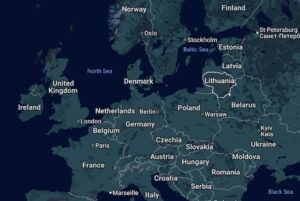
We have yet to talk about the big elephant in the room – Russia (Kaliningrad) and Belarus. These neighbors provide real concern about Lithuania’s geopolitical position.
As a NATO and EU member, this should quell some investors’ fears about Lithuania’s geopolitical instability. And in being completely energy independent, they’ve effectively eliminated Moscow’s leverage over electricity flows.
Yet, risks such as Russian DDoS and cyber-attack campaigns (like the 2022 Killnet) are not one-off concerns, and must be assumed in long-term resiliency planning. The NIS2 framework is important in this regard, as Lithuania seems more than aware of these threats, and more importantly, prepared.
There is also a concern with infrastructure security, specifically undersea cables. In response, NATO earlier this year formed “Baltic Sentry”, a new military program to “strengthen the protection of critical infrastructure”.
Yet, one cannot ignore the outright animosity in the region, and Russia’s coercive maneuvers, hostile positioning and rhetoric requires its Baltic neighbors be on a heightened security posture at all times. There is an objective need for more advanced incident protocols in the region, to manage real geographic risks that other EU countries don’t share.
Thus, while Lithuania’s NATO/EU status and 2025 grid synchronization have reduced structural dependence on Russia/Belarus, hybrid threats (cyber, undersea) remain a real, ongoing planning assumption. These risks are manageable, but they must be engineered in from day one.
Additionally, while Lithuania’s renewable goals are bold, the grid is still developing. Integration of variable wind and solar sources can cause load-balancing challenges, and large-scale data centers require stable, uninterruptable and redundant power.
Neighboring countries like Sweden and Finland already have excess generation capacity and more experience supporting hyperscale loads needed by DC’s.
Lithuania is still building its data center brand. The ecosystem of specialized contractors, suppliers, and technical workforce isn’t as deep as in Frankfurt or Dublin. For early entrants, that means potentially higher build costs, longer commissioning times, and steeper learning curves.
The Bottom Line
Lithuania’s fundamentals are solid: sustainable energy, efficient climate, strong connectivity, and a government that actually wants and is working to develop this business.
But it’s not a turnkey market – it’s a build-and-shape market.
For operators and investors willing to engage early, Lithuania offers first-mover advantage and cost-efficient positioning in the EU’s underdeveloped East-Nordic corridor.
It’s not at a “Frankfurt-level” readiness, but that’s a good thing. AI is not going to slow down (at least in terms of infrastructure), and DC’s are the requisite commodity for that development.
For many data-center developers and AI/capacity providers, the factors mentioned add up to a compelling site thesis: efficient cooling, renewable energy alignment, strong connectivity, and a business environment ready to compete.
If Lithuania continues its current trajectory, there is no doubt of it being a competitive and viable market. It’s a matter now of which investors are willing to take the risk now, and are patient enough for the inevitable payoff.